


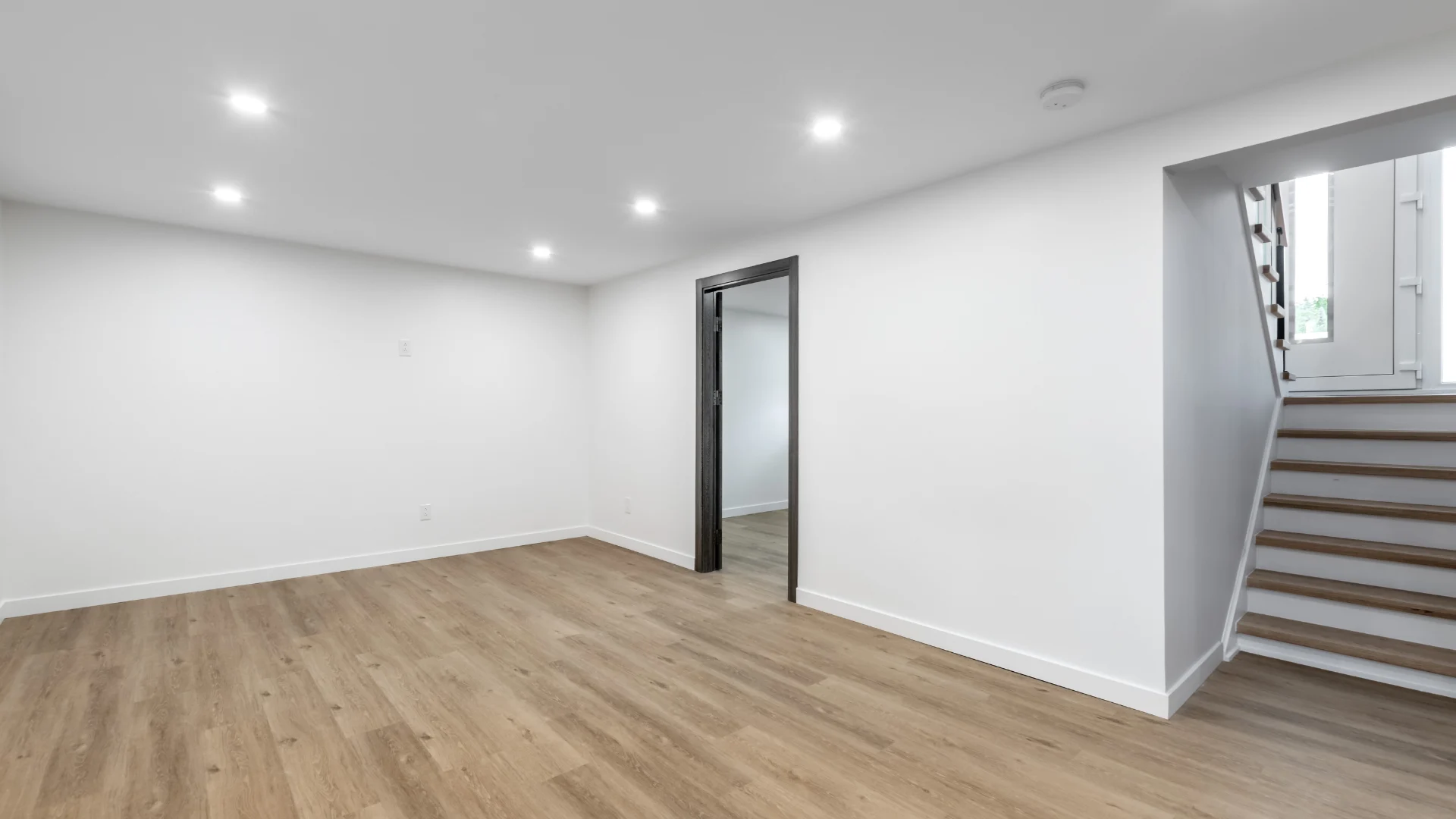
An unfinished basement usually tells on itself. You can see the damp corner. You can smell the mustiness near the wall. You notice the stain on bare concrete and realize something needs attention.
A finished basement is different. It can stay looking “mostly fine” while moisture moves quietly behind the walls, under the flooring, or into the insulation. That is what makes spring moisture so much more expensive in a finished space. By the time the problem becomes obvious, it has often already spread further than homeowners expected.
Health Canada warns that mould can be hidden behind walls or above ceiling tiles and emphasizes that moisture problems need the underlying cause fixed or mould will return. It also recommends maintaining indoor humidity between 30 and 50 per cent and using a dehumidifier as needed in damp areas, which is echoed in Health Canada’s healthy home guide.
Why Finished Basements Are More Vulnerable in Spring
Spring combines thaw, rainfall, and humidity changes in a way that finished basements do not handle gracefully. Concrete stays cool. Exterior drainage weaknesses become active again. Moisture can enter slowly through the foundation while the finished materials trap or hide the evidence.
That is why a finished basement may not show a puddle at all. Instead, you notice a baseboard separating from the wall, a section of flooring that feels slightly soft, a faint smell that comes and goes, or one area that always seems cooler and damper than the rest.
City Wide Group’s post on 10 warning signs your basement needs waterproofing is a strong fit for this topic because several of those signs become harder to interpret once walls and floors cover the structure. In a finished basement, you may only get the subtle signs at first.
What Moisture Damages In A Finished Basement
The obvious concern is drywall, trim, flooring, and paint. But those are only the start. Moisture can affect insulation inside the wall, wood framing, stored contents, area rugs, soft furniture, and electrical finishes. If the basement is used as a family room, home office, guest area, or rental suite, the practical disruption is much greater than in a bare utility space.
Health Canada also notes that exposure to mould can lead to health effects like irritation and can worsen asthma symptoms. Even when the visible damage seems minor, the hidden indoor air quality issue can be a much bigger concern for the people actually using the space every day.
That is the part homeowners often underestimate. The cost is not just the waterproofing itself. It is the demolition, drying, disposal, repairs, and lost use of a part of the house that had become real living space.
Why Spring Moisture Gets Hidden Instead of Noticed
Finished basements are designed to look comfortable. Rugs cover the floor. Furniture blocks the perimeter. Drywall hides the concrete. Shelving and storage get pushed against exterior walls. Ironically, all of that can make moisture harder to spot and airflow worse.
If the first clue is a smell, the natural reaction is often to blame the season. People assume the basement just feels “a bit closed up” after winter. That delay can be costly. A moisture issue that might have been caught as a drainage fix in early spring can become a restoration project by summer.
City Wide Group’s February basement waterproofing tips for Ontario homes makes a practical recommendation that works here too: take note of small changes before they become big ones. In a finished basement, photos and simple observations can help reveal patterns you would otherwise miss.
Why Cosmetic Fixes Usually Backfire
A finished basement invites cosmetic thinking. Repaint the area. Replace the trim. Dry it out. Move the furniture back. The problem is that moisture hidden behind finished materials does not care how clean the room looks from the middle.
This is where City Wide’s exterior versus interior waterproofing guide is helpful. Their explanation that exterior systems prevent water from entering while interior systems manage water that has already gotten in gives homeowners a more realistic way to think about repair options. In a finished basement, the right solution is usually the one that protects the structure before you start redoing finishes.
If you repair the room without solving the moisture source, you are basically rebuilding on top of a problem that is still active.
Signs Finished Basement Owners Should Not Ignore This Spring
A musty smell that stays in one area is a warning. So is flooring that starts to cup, lift, or feel cooler than the surrounding sections. Watch for bubbling paint, staining near the base of the wall, rusting fasteners, swollen trim, and any dampness around below-grade windows.
Health Canada specifically says to check damp areas and places where water damage is known to have occurred because mould growth can be hidden. In a finished basement, that is a direct warning not to wait for obvious surface damage before acting.
Homeowners considering basement waterproofing Toronto services should think about the finished basement as both a moisture risk and a value risk. The more invested the room is, the more expensive the consequences of delay.
The Best Time To Deal With It Is While the Evidence Is Active
Spring is inconvenient, but it is revealing. The signs are easier to track. Drainage problems outside are visible. Moisture patterns inside tend to repeat more clearly. That makes diagnosis much easier than it is in a dry stretch of weather.
If the basement is finished and used regularly, it is worth acting at the first real sign of recurring moisture. In these spaces, “monitor it for now” often becomes an expensive sentence.
FAQs
Why is a finished basement more expensive to repair after a leak?
Because the damage is not limited to the concrete. Moisture can affect drywall, insulation, trim, flooring, furnishings, and air quality, which adds restoration and rebuilding costs on top of the waterproofing work.
Can mould grow even if I do not see standing water?
Yes. Health Canada says mould can be hidden behind walls or above ceilings and that damp materials can support growth even without obvious puddling.
Should I remove finished materials right away if I smell moisture?
Not always, but persistent odours, repeated dampness, or visible material changes should be investigated quickly. The priority is to identify the source and extent of moisture before deciding what needs to be opened up or replaced.